

A homeowner in Aurora wakes up with red welts on her shoulders for the third morning in a row. She searches for bed bug images, sees that the bites match what is on her skin, and calls a pest control company. The exterminator does a cursory inspection, agrees that bed bugs are likely, and quotes treatment. Two thousand dollars later, the welts are still appearing, and a second exterminator finally identifies the actual culprit: carpet beetle larvae living in a wool rug that her grandmother gave her three months earlier. The team at Hot Bugz sees this scenario regularly. Roughly one in five Denver-area customers who call about suspected bed bugs are actually dealing with carpet beetles, fleas, or another pest entirely, and the cost of treating the wrong problem is real.
Misidentification is the most expensive avoidable mistake in pest management. Three pests in particular get confused with each other constantly, and the differences between them are clearer than most homeowners realize.
The Misidentification Problem in Plain Terms
Bed bugs, fleas, and carpet beetles all produce skin reactions that look similar at first glance. Red welts. Itching. Reactions that appear overnight or after sleeping in a particular location. The visual similarity drives a lot of pest control calls toward the wrong service.
The cost asymmetry is the part that matters. A bed bug heat treatment runs significantly more than a flea treatment, which runs more than a carpet beetle treatment in many cases. Paying for the wrong service does not solve the problem and pushes the customer into a second round of inspections and treatments while the actual pest continues to cause reactions.
The diagnostic shortcuts most homeowners try (matching their bites to internet photos, asking a family member to confirm) are not reliable because the three pests produce visually similar skin reactions through completely different mechanisms. The reliable diagnostics are physical evidence and pattern recognition, not the bites themselves.
What Bed Bugs Actually Look Like (and What They Leave Behind)
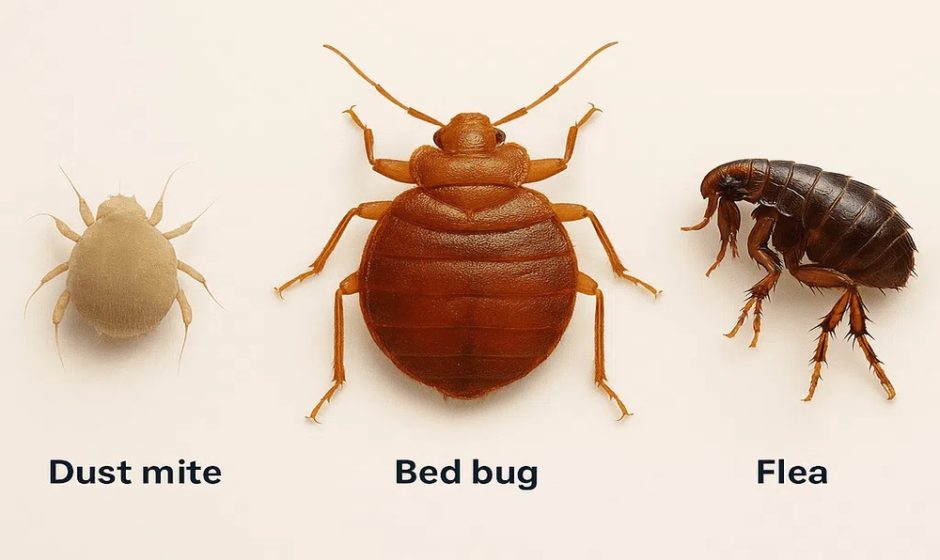
Adult bed bugs are roughly 4 to 5 millimeters long, flat, oval, and reddish-brown. They look like apple seeds. Nymphs are smaller and lighter, sometimes nearly translucent. They cannot fly or jump.
The physical evidence is the diagnostic standard. Dark fecal stains the size of a pen tip, concentrated in mattress seams and along bed frame joints. The smear test confirms these stains: a damp cotton swab pressed against a real fecal stain produces a rusty-brown bleed because the spot is composed of digested blood. Translucent shed exoskeletons accumulate in the same locations as the fecal stains. Pearl-white eggs, roughly 1 millimeter, glued in clusters into seam folds and crevices.
Bed bug bites typically appear in lines of three or more on exposed skin during sleep. Common locations include arms, shoulders, neck, and face. The pattern matters more than the individual bite. Roughly thirty percent of people show no skin reaction at all, so a non-reactive partner does not rule out bed bugs.
Bed bugs concentrate within a few feet of where the host sleeps. Eighty to eighty-five percent of infestations are within that radius. They do not infest pets, do not jump, and do not appear in random parts of the house away from sleeping areas.
What Fleas Actually Look Like (and Where the Bites Show Up)
Adult fleas are roughly 1 to 3 millimeters long, dark brown to black, with flat bodies that are tall and narrow rather than wide and oval. They jump. The jumping is the diagnostic give-away. A bug that hops several inches when disturbed is a flea, not a bed bug.
The physical evidence is different. Flea dirt (flea fecal matter) appears as small black specks in pet fur, on pet bedding, and sometimes on furniture or carpets where pets rest. The same wet-cotton-swab test works for flea dirt: it bleeds rusty-brown because, like bed bug feces, it is composed of digested blood. Adult fleas are visible jumping in carpets and on pets, particularly when a pet is groomed or shaken.
Flea bites appear in a different distribution from bed bug bites. They cluster on the ankles, lower legs, and around the waistline, because fleas live in carpet and bedding and bite where skin contacts those surfaces. Flea bites in the upper body are uncommon unless the host is sitting on or holding an infested pet.
The presence of pets is the single biggest predictor. Households with cats or dogs that go outside have flea exposure as a baseline risk. Households without pets rarely have fleas, though it does happen occasionally when previous occupants left an infestation behind or when wildlife (raccoons, squirrels, rodents) has been active in the structure.
What Carpet Beetles Look Like (and Why They Cause “Bites” That Aren’t Bites)
This is where the confusion gets dense. Carpet beetles do not bite. The skin reactions attributed to them are not bites at all.
Adult carpet beetles are small (1.7 to 3.5 millimeters), round, and patterned. The varied carpet beetle has a mottled pattern of white, brown, and yellow scales. The black carpet beetle is dark brown to black. The furniture carpet beetle has white, brown, and yellow patterning similar to the varied carpet beetle. Adults are often found near light sources (windowsills, lamps) because they are attracted to light.
The larvae are the actual problem. Carpet beetle larvae are wormlike, oval, and covered in coarse barbed bristles called setae. The varied carpet beetle larva has black and white striping with prominent bristles. The larvae are larger than the adult beetles and live in dark areas: under furniture, along carpet edges where carpet meets wall, inside wool rugs, in stored wool clothing, in feather pillows, in wool blankets, and in dust accumulations behind dressers.
The skin reaction that gets misdiagnosed as bed bug bites is carpet beetle dermatitis, an allergic reaction to the larval bristles. A 2020 case series published in the U.S. CDC’s Emerging Infectious Diseases journal documented eleven patients in southern France whose persistent skin lesions were initially mistaken for bed bug or flea bites and were eventually diagnosed as Anthrenus sp. larval dermatitis. The pattern is consistent across reported cases: the reactions appear under clothing where the larval bristles contact skin, not on randomly exposed sleeping surfaces.
The diagnostic differences are concrete. Carpet beetle reactions appear on skin under clothing or where skin pressed against fabric (a wool rug, a wool blanket, an upholstered chair). Bed bug bites appear on exposed skin during sleep. Flea bites cluster on ankles and lower legs. Fabric damage (small holes in wool sweaters, shed fibers in carpets, damaged feather pillows) is a strong carpet beetle indicator that bed bugs and fleas do not produce.
Carpet beetle larval reactions also vary substantially among household members. The Nice case series documented that within the same family, some individuals reacted strongly while others living in the same space had no symptoms. This is similar to the bed bug bite reaction variability but for a different underlying reason: dermatitis sensitivity differs between individuals more than puncture-bite reactivity does.
How to Distinguish Them in Five Minutes
A focused five-minute differential diagnosis works in most cases.
Check the mattress seams and box spring with a flashlight. Pen-tip-sized fecal stains that pass the smear test, translucent shed exoskeletons, or live bed bugs in this location are bed bug evidence. No evidence in this location, with bites concentrated on upper body, points away from bed bugs.
Check pets and pet bedding for flea dirt. Black specks in fur, especially around the base of the tail, that bleed rusty-brown on a damp cotton swab are flea dirt. Look for adult fleas jumping in carpet near where pets rest. No pets in the household and no flea dirt on furniture is strong evidence against fleas.
Check wool rugs, wool clothing, feather pillows, and the carpet edges where carpet meets wall. Look for small fabric holes, shed bristles in dust, or live larvae. Skin reactions that appear under clothing or after sitting on a wool rug, with no evidence in mattress seams and no flea dirt, point toward carpet beetles.
Note the bite distribution honestly. Lines of three on exposed sleeping skin = consistent with bed bugs. Cluster on lower legs and ankles = consistent with fleas. Scattered rash under clothing = consistent with carpet beetle dermatitis.
If after this inspection the picture is still unclear, professional inspection is more cost-effective than guessing. Hot Bugz performs bed bug inspections that include differential diagnosis. We will not recommend heat treatment if the evidence points to carpet beetles or fleas, and we will tell you directly what we found and what kind of professional you actually need.
What to Do If You Got the Diagnosis Wrong the First Time
Customers who paid for the wrong treatment the first time around should know that switching pests is common and not a sign of incompetence on anyone’s part. The diagnostic tools are imperfect, and three pests with similar skin reactions are genuinely difficult to distinguish without methodical inspection.
The right next step is a fresh inspection focused specifically on the differential diagnosis. The previous treatment’s chemicals or heat may have already shifted the pest population, so the current evidence picture may differ from what was originally there. A fresh look from a different professional, with the diagnostic framework above in mind, is usually decisive.
If you are in the Denver Front Range area and uncertain whether your bites are coming from bed bugs, fleas, carpet beetles, or something else, reach out to Hot Bugz to walk through the inspection and the differential diagnosis. We would rather tell you that you don’t have bed bugs and refer you to the right professional than treat for the wrong pest.